
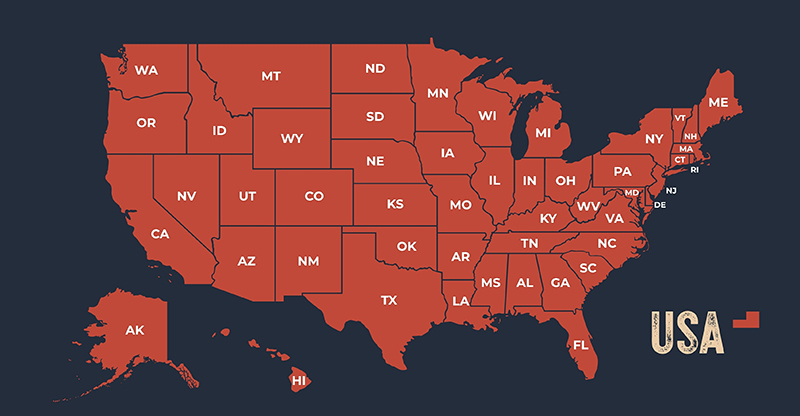
CME requirements by state differ more than most physicians expect, from the number of hours to the topics a board insists you cover. This hub explains how the rules vary, shows you where to look up your own, and summarizes 12 large states with links to our detailed guides.
We checked these requirements against each state medical board’s website (and the Federation of State Medical Boards CME overview). Rules change, so confirm with your state board before your renewal.
The short answer
- Most states require between 40 and 150 hours of CME, usually over a two- or three-year cycle tied to license renewal.
- Many boards set a minimum share of AMA PRA Category 1 Credit™ (or AOA Category 1-A for DOs), and the rest can be other credit types.
- Nearly every state adds topic mandates, such as controlled substance prescribing, ethics, implicit bias, or child abuse reporting.
- Some states license DOs through a separate osteopathic board with its own rules, so MDs and DOs in the same state can have different requirements.
- Your state board’s website is the final word. The FSMB’s board-by-board CME overview is a good place to start.
How state CME requirements vary
No two boards write their rules the same way. When you compare states, five things tend to change.
Total hours
The total ranges widely. Georgia asks for 40 hours every two years, while Illinois and Michigan each require 150 hours over three years. Bigger numbers usually come with longer cycles, so the yearly load is closer than the headline totals suggest.
Cycle length
Most boards tie CME to the license renewal period, which is commonly two or three years. Some cycles start on a fixed date, and others follow your birthday or the date your license was issued. Check exactly when your window opens and closes, because hours earned outside it usually don’t count.
Category 1 share
Many states require a portion of your hours to be AMA PRA Category 1 Credit™ or AOA Category 1-A. Pennsylvania’s medical board, for example, requires 20 of its 100 hours to be Category 1, and Michigan requires at least 75 of 150. North Carolina requires all 60 of its hours to be Category 1. If you’re unsure what counts, our guide to AMA PRA Category 1 Credit™ explains the credit types.
Topic mandates
This is where most physicians get caught. Boards add required topics that sit inside (or on top of) the total, and new ones are added with some regularity. Common examples include pain management and controlled substance prescribing, medical ethics, implicit bias, human trafficking, child abuse recognition, and end-of-life care. Some are one-time requirements and others repeat every cycle.
Separate osteopathic boards
In some states, DOs are licensed by a separate osteopathic board. Among the 12 states below, California, Florida, Pennsylvania, and Michigan each have one, according to the FSMB overview. The osteopathic board may require AOA credit and set a different Category 1 minimum. California’s Osteopathic Medical Board, for example, requires 50 hours every two years with at least 20 in AOA Category 1A or 1B.
How to find your own state’s requirements
Third-party summaries can be out of date. Use them to get oriented, then confirm with official sources.
- Open the FSMB’s Continuing Medical Education board-by-board overview (a PDF, last updated August 2026 when we checked) and find your state’s MD or DO row.
- Go to your state board’s website and look for a continuing education or license renewal page. If you’re a DO, make sure you’re on the right board.
- Note the total hours, the cycle dates, the Category 1 minimum, and each required topic, including whether it’s one-time or recurring.
- Read any recent board news or rule changes, since new topic mandates often start mid-cycle.
- Keep your certificates. Boards such as Georgia and Michigan say they do not collect proof at renewal but expect you to produce it if audited or asked.
CME requirements by state: 12-state summary
The figures below are for MDs from each state’s medical board (or its official administrative code). DO requirements can differ where a separate osteopathic board exists. Each detailed guide covers Category 1 rules, topic mandates, and DO differences.
| State | Total CME hours | Cycle | Full details |
|---|---|---|---|
| California | 50 | 2 years | California CME requirements |
| Texas | 48 | 2 years | Texas CME requirements |
| Florida | 40 | 2 years | Florida CME requirements |
| New York | See article | See article | New York CME requirements |
| Pennsylvania | 100 | 2 years | Pennsylvania CME requirements |
| Illinois | 150 | 3 years | Illinois CME requirements |
| Ohio | 50 | 2 years | Ohio CME requirements |
| Georgia | 40 | 2 years | Georgia CME requirements |
| North Carolina | 60 | 3 years | North Carolina CME requirements |
| Michigan | 150 | 3 years | Michigan CME requirements |
| New Jersey | 100 | 2 years | New Jersey CME requirements |
| Massachusetts | 50 | 2 years | Massachusetts CME requirements |
New York is listed as “See article” because we could not confirm a general hour total from the state’s official pages. The state’s Office of the Professions does list mandated training for physicians, including child abuse identification and reporting, infection control coursework every four years, and three hours of pain management, palliative care, and addiction training every three years for DEA-registered prescribers.
A few state-specific notes
Texas requires 48 hours every two years, and at least half must be formal Category 1 or 1A. The board also requires ethics and pain management hours within those formal hours, plus an approved human trafficking course.
Florida’s board requires 40 hours each biennium for MDs, including two-hour courses on preventing medical errors and, for DEA registrants, controlled substance prescribing. Domestic violence is required every third cycle.
New Jersey requires 100 credits each biennium, with at least 40 in Category I. Two of those Category I credits must cover end-of-life care, and physicians must also complete six hours of cultural competency training.
Massachusetts lists 50 Category 1 or 2 credits for a full license, with 10 in risk management and several topic trainings, including implicit bias, electronic health records, and opioid education for prescribers.
Ohio requires 50 hours per registration period, with at least one hour on a licensee’s duty to report misconduct. Georgia requires 40 hours every two years, with a one-time three-hour controlled substance course for DEA registrants and a one-time professional boundaries course.
Earning hours that fit your schedule
Once you know your state’s numbers, the hard part is finding time. Travel Medical Seminars offers Audio-Digest self-study courses in a 10-credit short course and a 20-credit full course, each designated for AMA PRA Category 1 Credit™, that you complete online at your own pace. Topic mandates are a separate question, so check whether a given course is approved for a specific requirement before you count it. You can browse all courses by specialty, including internal medicine.
Sources
- FSMB: Continuing Medical Education, Board-by-Board Overview
- Medical Board of California: Continuing Education
- Osteopathic Medical Board of California: CME
- Texas Medical Board: Continuing Education Requirements for Physicians
- Florida Board of Medicine: General Renewal Requirements, Medical Doctor
- NYSED Office of the Professions: Mandated Training for Medicine
- NYSED Office of the Professions: NYSDOH Mandatory Prescriber Education
- NYSED Office of the Professions: Mandated Training Related to Infection Control
- Pennsylvania State Board of Medicine: CME for MD Unrestricted License
- Pennsylvania State Board of Osteopathic Medicine: CME for Osteopathic Physicians
- Illinois Administrative Code, 68 Ill. Adm. Code 1285.110
- Ohio Administrative Code 4731-10-02
- Ohio Revised Code 4731.281
- Georgia Composite Medical Board: Continuing Education and Other Required Training for Physicians
- North Carolina Medical Board: 21 NCAC 32R .0101
- Michigan LARA: MD Licensing Guide and FAQs
- New Jersey Board of Medical Examiners: End of Life Care
- New Jersey Board of Medical Examiners: Cultural Competency
- Massachusetts Board of Registration in Medicine: BORIM CME Requirements
- Massachusetts Board of Registration in Medicine: Renew my Physician Full License